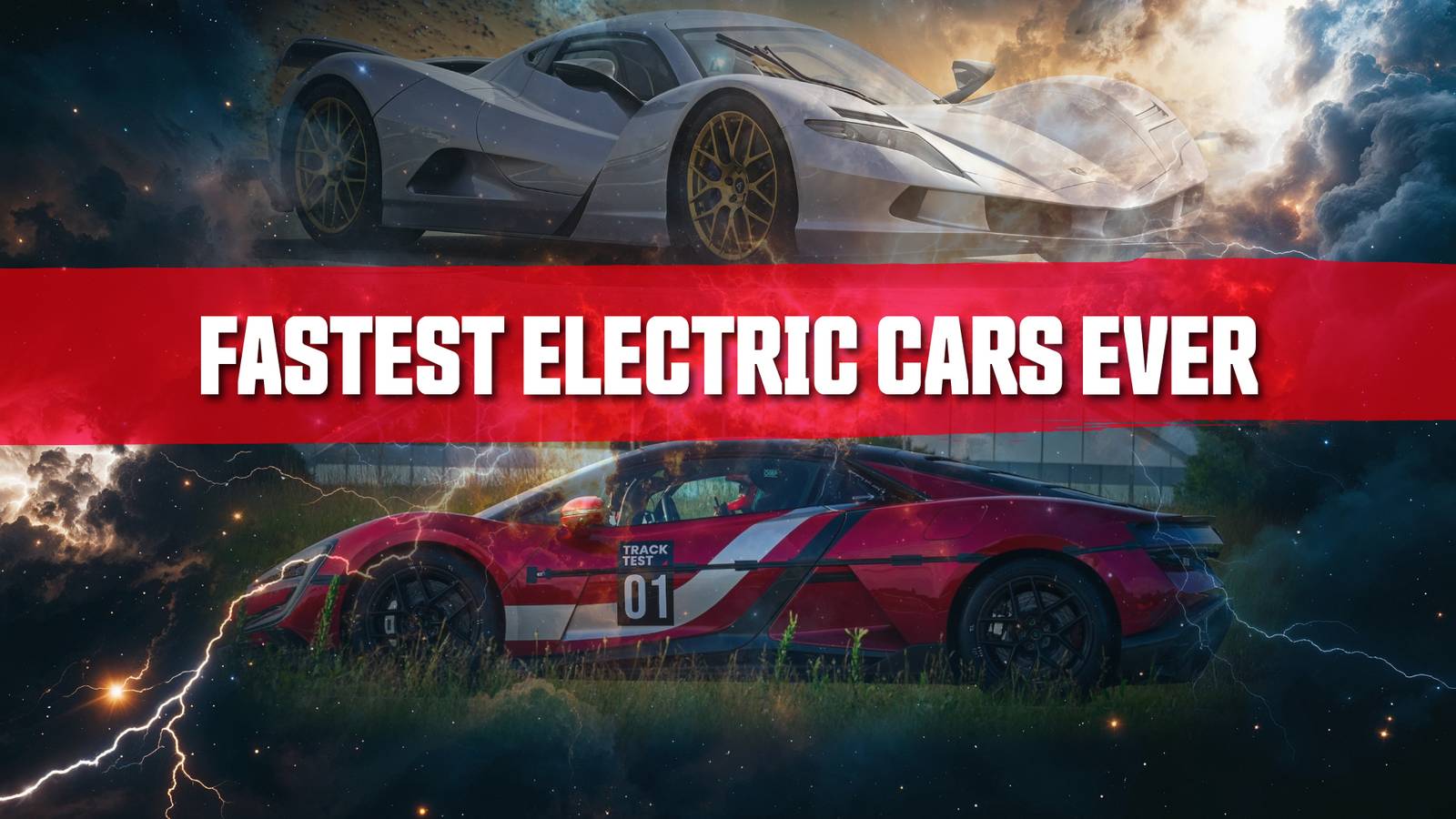
It seems as if every other week a new manufacturer claims to have developed the fastest EV in the world. This announcement is one that often causes big headlines and sets the bar even higher for rival manufacturers, as we’ve seen the title for world’s fastest electric car trade hands multiple times over the years. Everybody from Porsche to Tesla to Rimac with the Nevera – all have tried to claim the title over the years – and the latest champion might be even more surprising still. But how are these car companies able to further test the limits of how fast an EV can go – what goes on behind the scenes that make EVs consistently even faster? And, finally, who are really the top dog in the world’s fastest electric car wars?
Why EVs Are Fast – And Why They Keeping Getting Faster

EVs are constantly getting faster, more powerful, and pulling of crazy acceleration times – and the reason for that lies in the difference between what powers these cars, and those with traditional combustion engines. Gas engines have much narrower horsepower and torque peaks than those from electric motors. Additionally, electric motors provide instant torque without the need for power and torque to build, whereas gas engines go through engine revolutions that build horsepower and torque. Other reasons why EVs are so rapid include:
- Advanced battery tech: High-capacity batteries ensure large amounts of power are supplied quickly – ideal for high-performance driving
- Power is delivered efficiently: Single-speed transmissions mean time isn’t llost between gear shifts, like on multi-speed transmissions for gas-engined cars
- Optimal weight distribution: With heavy components at the bottom for a lowered center of gravity, handling and stability are superior in EVs
- Software and electronics: The flow of power from the battery to the motor is all controlled electronically for advanced performance and efficiency
As electric cars advance, so does the technology surrounding them, and we already know that living in a tech-forward society sees improvements (read: updates and upgrades) to all things software-based done in just minutes. So, it stands to reason, that electric vehicles will continue to evolve at a rapid rate, getting better and better – and quicker, and faster – all the time.
The battle for which EV is fastest is thus one that also changes. If you’ve lost track of who is currently at the top of the podium for the fastest EV in the world, you’re not alone – but this is how things stand. For now. In August, 2025.
To be eligible for this list, the electric cars in question must have verifiable records, and be production cars and not concepts. It’s worth noting that this list and the information on it is correct at the time of writing in August 2025 – but given how quickly technology evolves and how hot the competition is, it will change in the near future. Our definition of ‘fastest’ relates to top speed, while ‘quickest’ refers to acceleration time. We rank models from slowest to fastest/quickest – cars with the same top speed are differentated by acceleration.
The Fastest EVs In The World Ranked By Top Speed
5. 2025 Pininfarina Battista – 217 MPH

|
2025 Pininfarina Battista Overview |
|
|---|---|
|
Powertrain |
Quad-motor Electric |
|
Horsepower |
1,877 hp |
|
Torque |
1,726 lb-ft |
|
0-62 |
1.86 sec. |
|
Top Speed |
217 mph |
The Pininfarina Battista shares the same platform and technology as the faster Rimac Nevera we’ll meet later, but because of its custom aero and heavier weight, the Battista only hits 217 mph – a relatively low number considering what other cars on this list are capable of (and the same as the Evija). We rank it higher because it has a quicker 0-62 time by quite some margin. Still, this makes it the fourth-fastest EV you can buy today, beating out traditional gasoline-powered hypercars like the Ferrari SF90. Although this is a limited-run supercar, the Battista both looks and goes the part, and even if that top speed may be low for this list, it is one of the fastest electric cars in the world today.
4. 2025 Rimac Nevera – 256 mph

|
2025 Rimac Nevera Overview |
|
|---|---|
|
Powertrain |
Quad-motor Electric |
|
Horsepower |
1,914 hp |
|
Torque |
1,726 lb-ft |
|
0-60 |
1.85 sec. |
|
Top Speed |
256 mph |
The Rimac Nevera has the same top speed as the next entrant below it, but is fractionally slower to 60 mph, so we rank it a little lower. Top speed comes in at 256 mph top speed. The Nevera is the first full-scale production car for Croatian carmaker Rimac, which made headlines two years ago by buying Bugatti and half of Porsche from Volkswagen. The Nevera is another case of a new car by a small company blowing traditional automakers out of the water on both speed and power, signaling a shift in technological dominance in the EV space. The Nevera was also the record holder for fastest EV for over a year, a record that seemed to have been “unbreakable,” for quite some time. But it’s not the fastest car from the company, belive it or not.
3. 2025 Aspark Owl – 256 MPH

|
2025 Aspark Owl Overview |
|
|---|---|
|
Powertrain |
Quad-motor Electric |
|
Horsepower |
1,953 hp |
|
Torque |
1,416 lb-ft |
|
0-60 |
1.72 sec. |
|
Top Speed |
256 mph |
The Aspark Owl is a bit of an anomaly on our list. The Owl, produced by Japanese company Aspark, has just entered production and is already the second-fastest EV ever built, topping out at a whopping 256 mph, similar to the speeds of cars like the Bugatti Veyron and McLaren F1. Fortunately, some testing has proven the performance figures for the Owl, which is powered by a 1,953-hp powertrain, making the Owl one of the most powerful production cars on sale today. But, don’t get too excited – Aspark is only making 50 Owls, and they’ve all been spoken for.
2. 2025 Rimac Nevera R – 267 MPH

|
2025 Rimac Nevera R Overview |
|
|---|---|
|
Powertrain |
Quad-motor Electric |
|
Horsepower |
2,107 hp |
|
Torque |
1,726 lb-ft |
|
0-60 |
1.66 sec. |
|
Top Speed |
267 mph |
The Nevera R is the track-only version of the already-blisteringly-fast Nevera, with the automaker claiming the R stands for words like radical, rebellious, and relentless. The Nevera R has enhanced mechanical grip and downforce over the regular version, and also nearly 200 hp more. It features a lighter battery that is also more efficient – and it’s road legal. It decimated 24 different performance records that were previously held by the car it’s based on, including acceleration tests, braking evaluations, and more. It comes in as the second-fastest electric car by top speed.
1. 2025 YangWang U9 Track Edition – 293.5 MPH

|
2025 YangWang U9 Track Edition Overview |
|
|---|---|
|
Powertrain |
Quad-motor Electric |
|
Horsepower |
2,959 hp |
|
Torque |
TBC |
|
0-62 |
TBC |
|
Top Speed |
293.5 mph |
Clocking in at an unbelievable 293 mph, the YangWang U9 Track Edition has just recently smoked the entire EV world by becoming the new fastest EV on sale today. Despite being available only in China, for the time being, this new supercar just made waves at Germany’s ATP Testing Facility test track, taking the long-time crown away from the Rimac Nevera R. The U9 Track Edition is a spruced-up version of the regular U9, a supercar built by BYD subsidiary YangWang, a brand positioned to compete in the luxury and performance space. Little other information, like 0-60 time or price, is available on the U9 Track Edition, but we do know that it is powered by a 2,959-hp quad-motor battery. This means that the U9 is also one of the most powerful EVs to have come out in the last couple of years, giving Western automakers a run for their money.
The Fastest EVs In The World Ranked By 0-60 Times
5. 2025 Lucid Air Sapphire – 0-60: 1.89 sec.

|
2026 Lucid Air Sapphire Overview |
|
|---|---|
|
Powertrain |
Tri-motor Electric |
|
Horsepower |
1,234 hp |
|
Torque |
1,430 lb-ft |
|
0-60 |
1.89 sec. |
|
Top Speed |
205 mph |
We love that an American sedan takes the spot as the fifth-quickest EV by 0-60 times, dispatching the sprint in just 1.89 seconds. That’s super-car levels of acceleration, courtesy of the three electric motors under the sheet metal. It’s top speed isnt anything to sniff at either at 205 mph, but that’s not its most impressive metric – instead, rocketing to 60 mph in less time than it takes to say its full government name, the Lucid Air Sapphire does it all while ferrying a family of five (and their stuff). What’s more, it has a 427-mile range on a single charge – although flooring it for that impressive acceleration will significantly diminish that. That rapid take-off speed and highest range of any car on this list make the Sapphire the perfect performance car for both track and long-distance driving.
4. 2025 Pininfarina Battista – 0-60: 1.79 sec.

|
2025 Pininfarina Battista Additional Data |
|
|---|---|
|
Outputs |
1,877 hp | 1,726 lb-ft |
|
0-60 |
1.79 sec. (tested) |
|
0-62 |
1.86 sec. (claimed) |
|
0-124 |
4.75 sec. |
|
0-186 |
Under 10.49 sec. |
Appearing for the second time on this list is no surprise, considering the Battista has just under 1,900-horsepower on tap. The manufacturer claims a 0-62 mph time of 1.86 seconds – which is impressive enough on its own – but that drops to 1.79 seconds in independent testing, putting this supercar in fourth place of the fastest EVs in the world. Pininfarina also mentions that if you need to come to a stop after flooring the accelerator, the Battista can stop from 62 mph in just 100 ft.
3. 2025 Rimac Nevera – 0-60: 1.74 sec.

Rimac
|
2025 Rimac Nevera Additional Data |
|
|---|---|
|
Outputs |
1,914 hp | 1,726 lb-ft |
|
0-60 |
1.74 sec. |
|
0-62 |
1.81 sec. |
|
Qaurter-Mile |
8.25 sec. |
|
0-186 |
9.22 sec. |
The Rimac Nevera makes a second appearance on the ‘fastest EV you can buy today’ list, with a 0-60 time of just 1.85 seconds. The lightweight all-wheel-drive system and dedicated launch control ensure the Nevera literally launches forward at a rocket-like speed. For the first year of the Nevera’s life, it was the fastest accelerating car ever built, a feat that was only broken recently by the remaining cars on this list – one of which is the sister car to this incredible machine.
2. 2025 Aspark Owl – 0-60: 1.72 sec.

|
2025 Aspark Owl Additional Data |
|
|---|---|
|
Outputs |
1,953 hp | 1,416 lb-ft |
|
0-60 |
1.72 sec. |
|
0-62* |
1.78 sec. |
|
0-124 |
4.76 sec. |
|
0-186 |
9.74 sec. |
*Based on development testing
Until relatively recently, the Aspark Owl was the quickest electric car you can buy – managing that benchmark sprint in 1.72 seconds – two tenths of a second quicker than the Rimac Nevera. As we explained earlier in our list of EVs with the highest top speed, the Aspark Owl is a car from humble beginnings, starting out life as a small passion project within a newly formed Japanese car company that then took the world by storm. The company launched development and production in Italy, and quickly achieved the fastest average speed of the quarter mile by an electric car (198 mph). It weighs 4,519 lbs and has glorious falcon wing doors – a car that we hope to see more of in the coming years.
1. 2025 Rimac Nevera R – 0-60: 1.66 sec

|
2025 Rimac Nevera R Additional Data |
|
|---|---|
|
Outputs |
2,107 hp | 1,726 lb-ft |
|
0-60 |
1.66 sec. |
|
0-62 |
1.72 sec. |
|
0-124 |
3.95 sec. |
|
0-186 |
7.89 sec. |
Topping the list of fastest electric vehicles in the world is the Nevera R with acceleration figures that border on ridiculous. We can’t imagine that anything ever needed to go this fast – but we’re sure glad it does. This engineering marvel will dispatch the quarter mile in less than eight seconds, thanks to its lighter weight and aero design. The company started in 2009 when the idea of an electric supercar was born.
“Our goal is to showcase the pinnacle of engineering through our hypercars and advanced technologies. From the outset, our mission was to create the most exciting hypercar. Faced with the insufficiency of existing technology, we developed everything ourselves. Now, 15 years later, we are celebrating our journey with the launch of our latest marvel: the Nevera R.”
In just a bit over 15 years, Rimac has created not more than one incredible automobile, leaving records in its wake. The Nevera R was launched to celebrate the company’s 15th anniversary – so it’s fitting that this car tops our list.
For now, anyway.
Honorable Mentions
McMurtry Spéirling

Because it’s not in production (yet) – and the one prototype that’s done all the testing isn’t the production version – we can’t include the McMurtry Spéirling on our lists, but it’s fully worthy of a special mention. This is the electric singe-seater car known for being the first car to drive upside down courtesy of it’s exceptional “Downforce-on-Demand Fan System”, and for setting the fastest time at the Top Gear test track. It also pulls up to 3gs when cornering.
|
McMurtry Spéirling Overview |
|
|---|---|
|
Horsepower |
1,000 hp |
|
Drivetrain |
RWD |
|
0-60 |
1.55 sec. |
|
Quarter mile |
8 sec. |
Deus Vayanne

The Deus Vayanne is another special mention – an electric supercar from Austrian company Deus. At the time of writing, none of thee cars have been officially tested for top speed or acceleration records, and with only 99 scheduled for production, we’re not even sure how many have been made to date. We love how it looks, however, and have high hopes for the car – and company – in the future.
|
Deus Vayanne Overview |
|
|---|---|
|
Horsepower |
2,213 hp |
|
Torque |
1,505 lb-ft |
|
0-62 |
1.99 sec. (projected) |
|
Quarter mile |
8 sec. |
|
Top Speed |
250 mph |
Sources: Tesla, Lucid, Aspark, Rimac, Pininfarina Automobili, YangWang, Deus Automobiles, McMurtry.
link