Article content
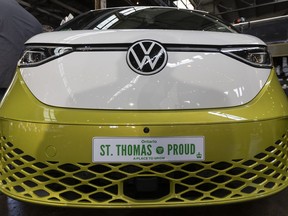
The bankruptcy of a Volkswagen partner in electric vehicle battery production will not threaten the automaker’s St. Thomas investment, industry experts say.
Article content
Article content
The development does, however, demonstrate increasing volatility in the EV sector during this high-tariff automotive environment, and the $7-billion PowerCo EV battery plant in Southwestern Ontario may face future delays, they said.
Advertisement 2

Article content
Northvolt, an electric vehicle battery maker, filed for bankruptcy in Sweden recently and Volkswagen is its largest shareholder with a 21 per cent stake in the company after a more than $700 million investment. It is not yet known how the bankruptcy will affect Northvolt’s North American operations including a planned EV battery plant in Quebec.
But the bankruptcy illustrates how quickly the sector can change, and the current automotive tariff threat by the U.S. federal government against Canada has worsened instability, said Joe McCabe, auto industry analyst and chief executive with AutoForecast Solutions in Pennsylvania.
“I don’t think this will put a screeching halt to the (PowerCo) investment, but there may be a delay or a scaling back. There are a lot of headwinds, more than six months ago,” he said.
The St. Thomas plant is expected to employ about 3,000 and supply batteries for VW vehicles being made in South Carolina and Tennessee when it begins production in 2027. Tariffs have been threatened on vehicles and parts exported into the U.S. starting April 2 with Canada pledging counter tariffs. Tariffs on Canadian steel and aluminum are already in place.
Article content
Advertisement 3
Article content
Along with tariffs, there is slowing demand for EVs, and government incentives on purchases have been repealed in Canada with the U.S. federal government also saying it will drop the $7,500 it gives to new buyers.
“The U.S. is the largest market for their product.,” McCade said. “There is a tariff issue, a consumer adoption rate issue and mandates dialled back in the U.S. These may cause a delay, they may kick the can down the road,” he said of PowerCo.
PowerCo Friday dismissed questions of changing market conditions delaying EV battery production, saying it remains on schedule for a 2027 opening in St. Thomas and the investment is a long-term strategy.
“Gigafactory St Thomas is a strategic, long-term investment with strong fundamentals, and we are confident in its potential to drive economic growth and create skilled jobs in Canada. We are focused on delivering a project with the right engineering and supply chain partners, and remain on track for initial production in 2027,” PowerCo said in an email message.
The company has begun work on a rail line into the plant and an electricity substation at the St. Thomas site. PowerCo has more than 100 workers.
Advertisement 4
Article content
Andreas Schotter, international business professor at the Ivey business school at Western University, agreed the Northvolt filing will have little effect locally, but said it raises “important questions” about the EV industry.
“I strongly believe that uncertainty lingers,” he said. “The real challenge, in my view, remains the erratic and unpredictable (U.S. President Donald) Trump tariff war. While these pressures won’t yet force a full cancellation of the project, delays seem increasingly likely. The shifting battery supply landscape, coupled with geopolitical and economic headwinds, suggests that Volkswagen may have to adjust its overall battery strategy and its timeline in Canada, the U.S. and Europe.”
PowerCo is the EV division of Volkswagen. Ontario won the plant against U.S. competition because of its supply of chemicals and minerals from northern Ontario critical to EV battery manufacturing, ample supply of power for the energy-hungry operation and federal and provincial incentives that matched what was offered by the U.S., McCabe said.
Advertisement 5
Article content
But the tariff threat poses a risk to automotive investment in Canada, as evidenced by Stellantis pausing a multibillion-dollar EV investment in its Brampton plant.
Recently former Innovation minister Francois-Philippe Champagne said the Liberal government would fight to ensure companies honour the investment commitment they have made to Canada.
As for global EV sales, according to recent reports from Bloomberg, sales of all-electric passenger vehicles and plug-in hybrids increased by 24 per cent in 2024. That’s down from a 33 per cent increase a year earlier and a more than doubling of sales in 2021.
Recommended from Editorial
-

Battery material from Quebec secured as VW plant groundwork pushes ahead
-

Trump tariff threatens Volkswagen’s $7B St. Thomas plans: Trade expert
Article content
link