While electric vehicles have been a solution to help manufacturers move closer to their carbon-neutral goals, electric vehicle batteries are still insufficient in terms of both driving range and charging time. The next step in the evolution of electric vehicle batteries is the development of solid-state batteries.
In a typical electric vehicle, a lithium-ion battery features a liquid electrolyte or a gel-based electrolyte. Still, solid-state batteries (SSB) utilize a solid electrolyte, which can be made from a variety of materials, including glass and ceramic. Why?

The promise of solid-state batteries is greater energy density, smaller form factors, greater heat resistance, and quicker charging times. They’re poised to revolutionize the electric vehicle segment, and nearly every leading automaker that produces electric vehicles has its sights on them.
From The Lab To The Real World

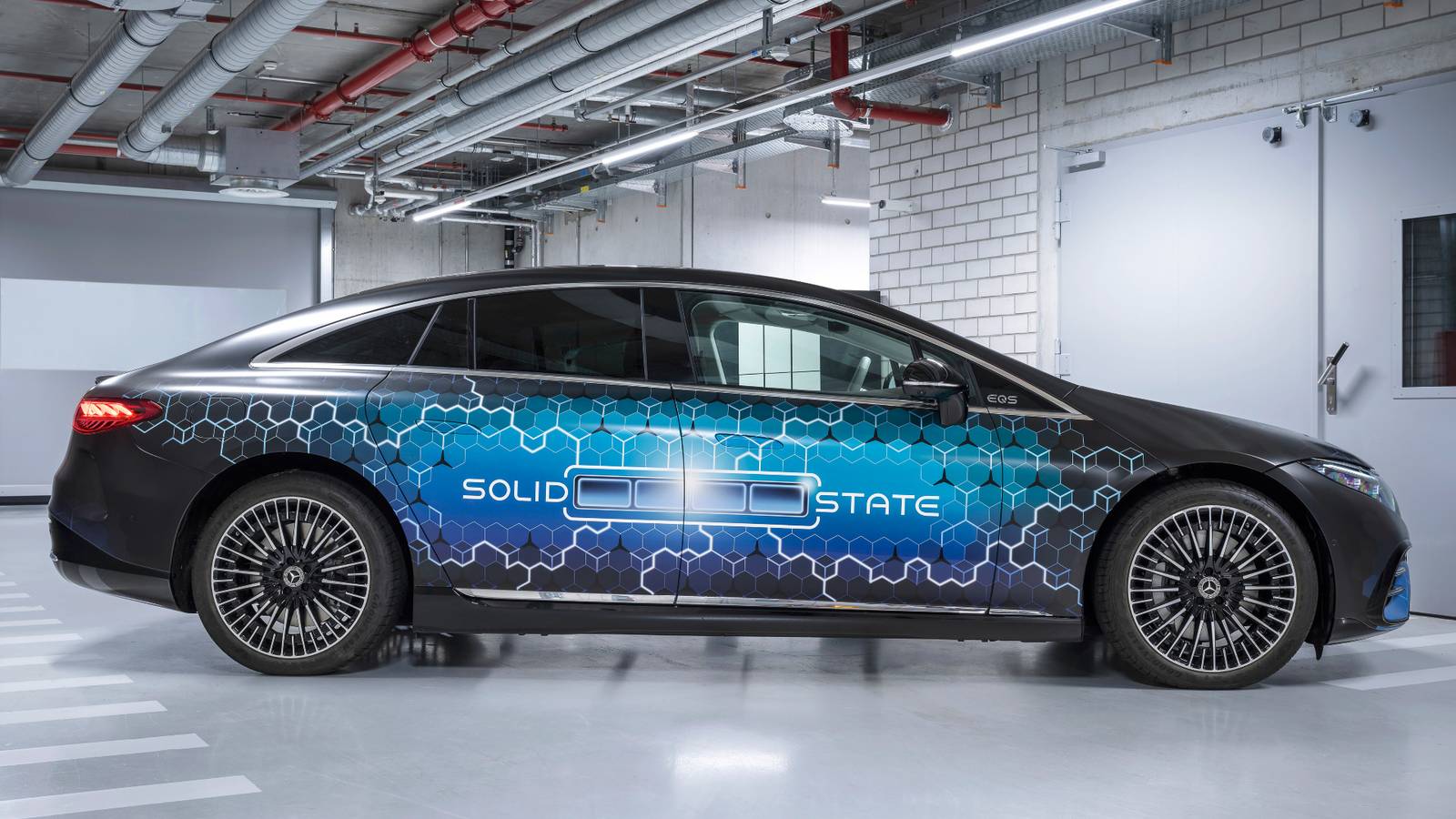
For the longest time, solid-state battery technology has been constrained to isolated and controlled testing in lab conditions. However, on February 24, 2025, Mercedes-Benz announced that it had successfully integrated a lithium-metal solid-state battery into a production vehicle platform, marking the first car powered by a solid-state battery to be on the road. This breakthrough in solid-state battery technology has been achieved through the collaboration of Mercedes-Benz and Factorial Energy, who specialize in solid-state batteries.

Pros And Cons Of Solid-State Batteries: Are Solid-State Batteries The Savior of The EV?
A lot has been said about solid-state batteries. Here are the facts about the pros and cons associated with this next-gen technology.
At the end of 2024, a lithium-metal solid-state battery was successfully installed in a slightly modified Mercedes-Benz EQS, which began laboratory testing shortly after in preparation for road tests scheduled to start at the beginning of 2025. The results were impressive. Compared to a Mercedes-Benz EQS with the same battery size and capacity, this prototype Mercedes-Benz EQS has a 25% longer driving range, with an estimated total driving range of 620 miles. In contrast, the equivalent production EQS model has a driving range of just under 500 miles.

“Developing an automotive-scale solid-state battery underlines our commitment to innovation and sustainability. We’re therefore excited to announce that we’ve started road testing with a prototype vehicle equipped with this advanced technology. We will gain crucial insights into possible series integration of this cutting-edge battery technology.” – Markus Schäfer, chief technology officer, Development & Procurement.

Subaru’s First Solid-State Batteries Are Here, But They’re Not What You Think
You might know the battery supplier.
BMW also trialed solid-state batteries in a BMW i7 test vehicle earlier this year. The German automaker partnered with Solid Power, a company that, like Factorial Energy, specializes in solid-state battery cells. BMW has upped its efforts alongside Solid Power since 2022 through its technology transfer agreement. In the BMW i7 test mule, a sulfide-based solid electrolyte was employed, with which the company hoped to investigate battery cell expansion and temperature control. This comes after the company faced issues with its solid-state battery plans in 2023.

“Our BMW i7 ASSB test vehicle on the road is a perfect example of the BMW Group’s technology-open mindset. We are continuously advancing the development of new battery cell technologies and are constantly expanding our know-how with valuable partners such as Solid Power.” – Martin Schuster, BMW Group vice president Battery Cell and Cell Module
These are two of the most notable instances of solid-state batteries entering the road testing phase. Other prolific manufacturers, including Nissan and Toyota, have their sights set on road testing, with both companies previously stating that we can expect to see electric vehicles with solid-state batteries in their vehicles by the latter half of the 2020s. Toyota’s due date is set a bit earlier than Nissan’s.
Refining The Technology

While solid-state batteries are finally making their way into road-going vehicles, considerable effort is being put into improving this already promising technology. Hyundai was one of the most recent examples of improvements made to SSB technology. The Korean automaker unveiled its breakthrough in solid-state battery cell chemistry, which promises to reduce production costs while making solid-state batteries easier to produce by using simpler metals, specifically copper.
Hyundai’s solid-state patent proposes using a copper anode layer coated with a protective material to prevent corrosion, which was previously a hindrance to the use of copper in this manner. The patent envisions a solid-state battery with six layers, namely: a copper anode collector layer, a protective coating layer, an additional anode layer, a solid electrolyte layer, a cathode layer, and finally, a current collector layer. However, it’s worth mentioning that Hyundai filing a patent doesn’t guarantee that we’ll see this technology used in road-going models in the future.

Dodge’s Solid-State Muscle EV Is Already On The Back Foot
Stellantis will be one of the first automakers to offer solid-state batteries for cars in the US, but the tech lags behind what China has promised.
Another notable name in this regard is Stellantis. Near the end of April this year, Stellantis announced that it had made significant strides in the performance of its solid-state engines. Like Mercedes-Benz, Stellantis has partnered with Factorial Energy, which has successfully validated Factorial Energy’s solid-state battery technology, boasting impressive specifications. These batteries have an energy density of 375 Wh/kg, which is substantial and marks a significant step forward in realizing commercial applications.

Alongside that is its charging time, which is one of the main go-to “gotcha” for electric vehicle naysayers, with the Stellantis SSBs promising a charge time from 15% to over 90% quicker – in 18 minutes at room temperatures in some cases. This is a big deal, not only for charging times that have been one of the biggest detractors from the appeal of EVs to many, but also the fact that this is possible without overheating of components or a need for a cold environment to offset overheating issues.
“Reaching this level of performance reflects the strengths of our collaboration with Factorial. This breakthrough puts us at the forefront of the solid-state revolution, but we are not stopping there. We continue working together to push the boundaries and deliver even more advanced solutions, bringing us closer to lighter, more efficient batteries that reduce costs for our customers.” – Ned Curic, Stellantis chief engineering and technology officer.
Environmental factors also significantly impact battery performance, particularly in cold weather conditions. However, one of the most noteworthy breakthroughs Stellantis revealed was that its batteries could still perform in temperatures ranging from -22°F to 113°F, which greatly surpasses the previous solid-state battery limitations, thereby expanding the range of potential applications.
By The End Of The 2020s

That’s when we can expect to see solid-state batteries in road-going production cars. Remember, we mentioned Toyota and Nissan had plans for this decade? Toyota claims its batteries will be suitable for both charging and discharging in disaster situations, resulting in a battery that offers more power in a smaller form factor. Toyota states it has overcome challenges related to battery lifespan and, as such, has set its sights on mass production by 2027. The first incarnation of its solid-state batteries will offer a 20% increase in cruising range, with charging times of 10 minutes or less.
“We will need various options for batteries, just like we have different variations of engines. It is important to offer battery solutions compatible with a variety of models and customer needs.” – Takero Kato, president of the Toyota BEV factory.
As for Nissan, its European branches’ product planners spoke to AutoExpress, stating that Nissan is on track to introduce solid-state batteries by the end of this decade, with 2028 earmarked as the target date. There are more automakers involved in SSB development, which include Ford, General Motors, and Porsche, who say that SSBs will be rolled out in three phases, with the first being in motorsport or aviation applications, then in high-end performance vehicles, and finally across all applications once the issue of production costs and performance improvements is addressed. Until then, we wait.
Sources: Mercedes-Benz, Factorial Energy, Solid Power, BMW, Porsche, Toyota, Nissan, Stellantis
link