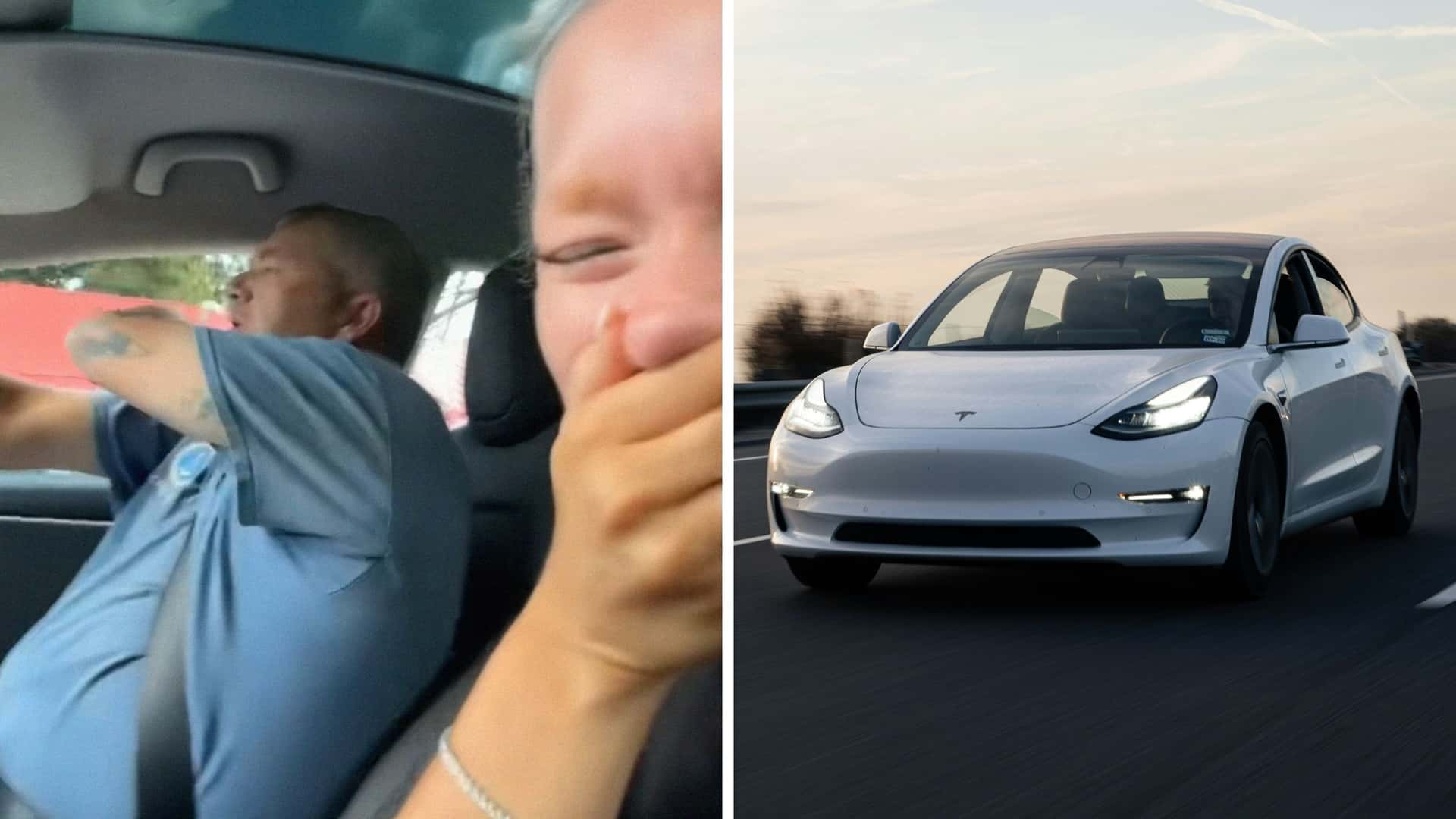
Every electric vehicle has a moment when it stops being an idea and becomes an experience. For one skeptical dad taking his first turn behind the wheel in his daughter’s Tesla, that moment arrived the instant he pressed the accelerator.
The viral TikTok clip from creator Anastasia Gentry (@anastasiagentry) captures her father’s disbelief at her Tesla’s performance. After a laugh-inducing expletive, he admits his expectations were blown away: “I ain’t never felt nothing like that!” he said in the clip that’s been viewed more than 430,000 times.
Gentry sets the scene in the video overlay text: “POV: Your dad DOGS you for getting a tesla but then he drives yours & changes his mind real quick.” She adds in the caption that her dad used to drag race and still calls this “the fastest car he’s ever been in,” which explains the mix of shock and admiration on his face as the torque hits.
We don’t know exactly which Tesla he’s driving, but even the “everyday” performance numbers help explain his reaction. The latest Model 3 Performance, for example, is rated at 2.9 seconds from 0-60 mph by Tesla, with independent testing clocking it at around 2.8-3.0 seconds, territory that used to be reserved for serious supercars.
In the comments, viewers immediately nominate Dad for an upgrade. “Someone get this man into a Model S Plaid stat!” one user jokes, referencing the tri-motor Tesla flagship that hit 60 mph in just over 2 seconds in recent tests.
Others use the clip to reinforce a familiar EV talking point: Critics often haven’t actually driven one. “People who don’t like them have never driven one and it shows,” one commenter writes. Another admits, “I hated electric cars. Decided to test drive one and well it came home with me.”
Several users weighed in, saying they’ve tried Teslas and still don’t enjoy them. “It wears off quickly, it has no character or soul, just a futuristic tablet on wheels,” one critic writes. Another complains that the minimalist cabin “feels cheap” compared with luxury brands, while fans counter that refreshed Model 3 and Model Y interiors use more upscale materials than earlier cars and that many modern EVs now rely heavily on big touchscreens.
Viral bits from across the social media landscape
Our team of experts tracks what’s trending so you don’t have to—from viral videos to online debates that have everyone talking.
Why EV Acceleration Feels So Different
Part of what makes clips like Gentry’s so shareable is that EV acceleration feels different, even if you’re used to fast gasoline cars. Unlike internal combustion engines, electric motors can deliver maximum torque almost instantly from a standstill, so there’s no waiting for the engine to rev or a transmission to kick down. That’s why even many mainstream EVs feel quicker around town than similarly priced gas cars.
That instant surge, combined with the relative quiet of an electric powertrain, can make the speed almost disorienting. Federal and state energy agencies routinely highlight instant torque and a quieter cabin as core EV benefits, alongside lower running costs and reduced tailpipe emissions.
For someone whose performance benchmark comes from old-school drag racing, that smooth, silent shove can be a shock to the body and to long-held assumptions about what a “real” fast car feels like.
If Gentry’s dad’s reaction feels familiar, there’s some research behind it. Studies of EV outreach programs and ride-and-drive events have found that even short test drives tend to improve how people rate electric cars on comfort, performance, and even perceived reliability, and often increase their stated willingness to buy one.
One analysis of EV test-drive programs found that participants’ likelihood of purchasing an EV rose significantly after getting behind the wheel and that dealerships noticed a bump in EV sales linked to those events.
The TikTok comments echo that pattern. “I hated Teslas until I drove one. It’ll be the next car I buy,” one user says. Others describe being dead-set against EVs until a rental, Uber ride, or family member’s car changed their mind, sometimes in a single weekend. At the same time, a vocal minority in the thread insists that even firsthand experience doesn’t cure their skepticism.
Range Anxiety Remains
Multiple Tesla owners praise the convenience of home charging, noting that most of their driving is local commuting and that waking up to a “full tank” every day beats regular gas station stops. That lines up with federal data showing that most U.S. trips are well under 50 miles and studies finding that the median range of new EVs now exceeds 250 miles on a charge.
Others, though, say they still can’t get past range limitations and road-trip charging. Recent polling backs up that concern: even as the public fast-charging network grows and federal funding pushes toward a national charger build-out, around four in 10 U.S. adults still cite range and charging time as major reasons they’re hesitant to buy an EV.
There’s also the intangibles: brand perceptions, build quality, and the politics surrounding Tesla’s leadership. In the replies, one user dismisses the whole clip as “Tesla propaganda.” In contrast, others say they like EVs but prefer rival models from Hyundai, Kia, Audi, or Porsche for their interiors or styling.
For all the comments about tax credits, interiors, or DC fast-charging, what made this clip go viral was simple: a dad who talked smack about his daughter’s car got his worldview rearranged by a single press on the accelerator.
It’s a small, funny moment, but it illustrates something automakers and EV advocates already know. You can argue online about range, emissions, or build quality all day, but the most powerful sales pitch for an electric car is still that first stomp on the pedal.
InsideEVs reached out to Gentry via direct message and comment on the clip. We’ll update this if they respond.
link