
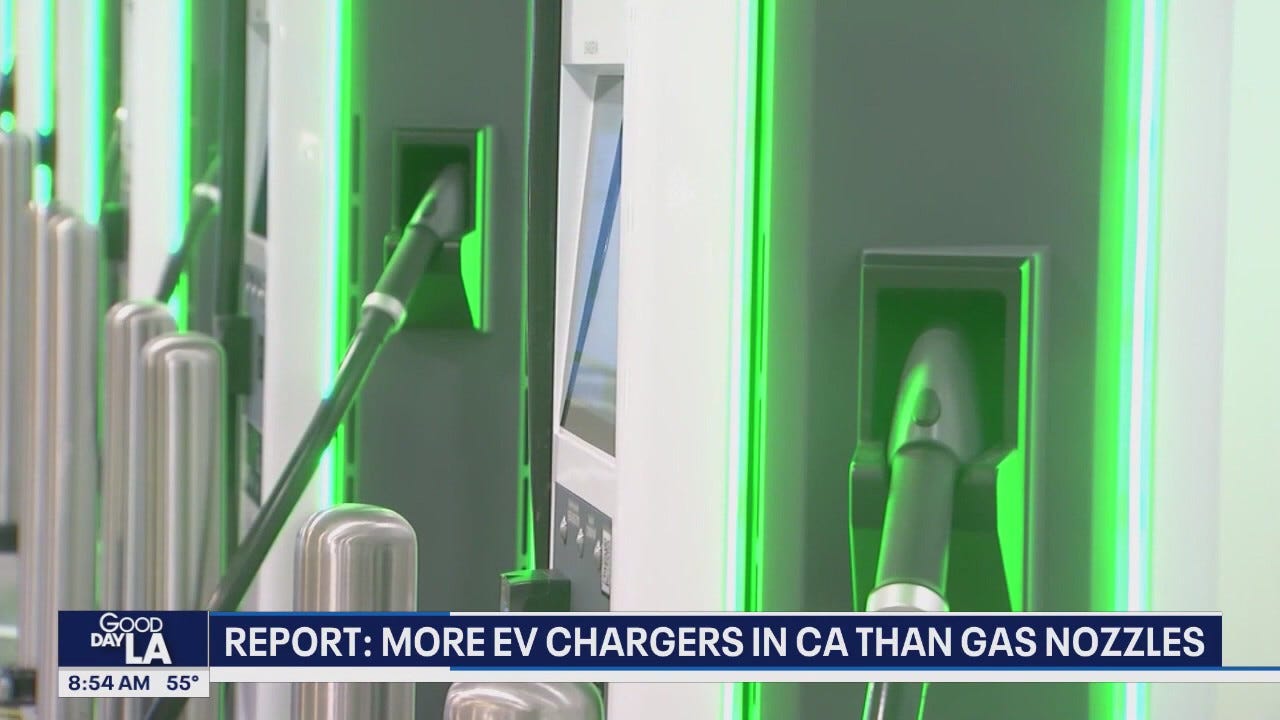

California has more EV chargers than gas pumps
California says that the number of public EV chargers in the state has officially exceeded the number of gas pumps in the state.
Fox – LA
- Certified adapters often cost $200-$250.
- Using the wrong adapter could damage your vehicle and the charger.
Electric vehicle owners, beware: Buying a cheap, unapproved converter to connect your EV to a Tesla DC fast charger — or connect your Tesla to the more common CCS charger — could damage your vehicle.
Experts agree the best course is to use the adapter your vehicle’s manufacture recommends. They typically cost $200 or more. You can find adapters for under $100 on Amazon, but cheap, off-brand devices could be less efficient and not as reliable.
Worst case, it might damage your vehicle and void the warranty.
“If an adapter overheats, it can melt and damage the inlet on your vehicle and the charger,” said Ted Bohn, the engineer at Argonne National Laboratory who chaired the public-private committee that created the safety standard for adapters you can rely on.
A melted adapter could essentially weld your vehicle’s inlet port to the charging cable, rendering both inoperative.
High voltage, high stakes
DC fast chargers are complicated devices that carry high electric voltages. They connect a big expensive vehicle to a charging kiosk that almost certainly costs more than the vehicle.
What could go wrong?
Plenty, and a faulty adapter could leave you on the hook for damage to both. The tab can easily run into thousands of dollars.
A bad adapter might even expose vehicles and chargers — conceivably, even your home — to cybersecurity threats.
Automaker-approved adapters are available from new car dealers and automakers’ websites and apps.
“It’s important to stick to the adapter your vehicle manufacturer specifies,” Consumer Reports Associate Director of Automotive Testing Gabe Shenhar said. “People who bought cheaper alternatives had problems, including voiding their warranty and the adapter overheating.
“It’s not worth saving a few bucks on something that could damage your vehicle.”
Why do I need an adapter to charge my EV?
EV owners typically use DC fast chargers when they drive long distances or don’t have access to a Level 2 (240 volt) charger to fill their battery overnight or at work. Run by companies like Electrify America, EVgo, Ionna and Charge Point, DC fast chargers — as the name suggests — deliver high levels of power to charge the battery quickly, so the vehicle can get back on the road.
Most EVs use what’s called a CCS, or combined charging system, plug. Teslas have a different plug, called NACS, or North American charging system.
The two are incompatible because Tesla built its DC fast chargers first. It kept the design proprietary, so only Tesla vehicles could charge at its kiosks, which the company calls Super Chargers.
The network of fast, convenient chargers gave Tesla a major sales advantage. Imagine what it would’ve been like in 1910 if Ford owned most of the gas stations in America, and only Fords could fill up at them.
Getting back to the present, it took other automakers a while to catch on, but they eventually agreed on the CCS design. They and independent charging companies built thousands of them around the country.
Now anybody can use Tesla’s chargers
Result: A VW or Chevy EV owner couldn’t charge at a Tesla station, and vice versa. On top of that, NACS chargers earned a reputation for being faster and more reliable than CCS.
They were seen as the gold standard.
Today, there are about 17,000 NACS charging stations and something over 18,000 CCS stations in the United States. The numbers are continually increasing, due to EV sales and rising demand. That compares with 145,000 gas stations nationwide. Concern about access to chargers held EV sales back.
Automakers negotiated to get their vehicles access to Tesla’s network.
To solve that, engineers from automakers, charging companies, the U.S. Department of Energy and others created a standard for adapters to connect CCS vehicles to NACS chargers. Doubling the number of places to fast-charge was a boon to automakers, but, initially, owners couldn’t buy an adapter. It still was like trying to plug an English appliance into an American outlet: The plugs didn’t match.
Why did my adapter cost $225?
SAE International, the engineering group that created standards for everything from lubricating oil to how heavy a trailer a vehicle can safely tow, oversaw standards for reliable adapters that work with all vehicles and chargers.
Called J3400/1, the standard specifies performance for charging, durability, use in all kinds of weather and more. They also shut down before damage occurs if something goes wrong and the adapter starts to overheat.
Any adapter stamped UL 2252 has been certified to meet those standards by UL Solutions, the long-standing independent testing group once known as Underwriters Laboratories.
“The requirements outlined in the standard are designed to ensure that an adapter meets safety standards not only when it’s first used but continues to meet them over time — even after typical wear and tear from everyday use,” said UL Solutions engineer Joe Bablo.
An EV adapter isn’t an overpriced extension cord. It’s a sophisticated safety device.
G’head, run a pickup over it
Adapters that meet the standards have been certified to work for years in all weather conditions, endure repeatedly being dropped to the ground and more. A Ford video shows the automaker’s adapter surviving being driven over by an F-150 Lightning full-size electric pickup.
Adapters that don’t meet SAE standard can even present cybersecurity concerns.
Some early adapters had USB ports so they could be updated. The ports left them open to hacking. The standard bans that: Adapters are now like an air-gapped computer, with no data link to the outside world.
“GM designed our adapter to meet the same standards as our vehicles,” GM Energy Chief Operating Officer and Head of Public Charging Bill Hotchkiss said. “We tested it in fleets of vehicles.
“Our chargers are good in all conditions: hot, cold, heavy rain, through thousands of use cycles. These are high-voltage connections. We want to make sure our customers are secure.”
Contact Mark Phelan: [email protected]. Follow him on Twitter @mark_phelan. Read more on autos and sign up for our autos newsletter. Become a subscriber.
link