
California’s EPA waivers get rescinded, Mitsubishi looks to sell Foxconn-built EV, and all the other automotive news overshadowed by Trump’s trade war


Article content
In war, truth is the first casualty
—Arthur Ponsonby, in Falsehood in War-Time
Article content
Article content
The ability to focus is an amazing virtue. It lets a mediocre mind — yours truly’s, for instance — to reason beyond natural capacity, and encourages great intellects to change the way the world thinks. Athletes become champions, painters renowned artists, and businesses thrive when their leaders remain focused (or, conversely, languish, á la Tesla, when their CEO’s mind wanders). Focusing all our national will, for instance, on Trump’s existential threats against Canadian industry is the only way that a lesser country such as ours can hope to stave off the threat on our southern border.
Advertisement 2
Article content
The problem with such focus is that by its nature — the concentration of mental effort on but one singular purpose — one can miss other, not-necessarily-lesser tasks. Like not “celebrating” marriage anniversaries (I’m still paying for that one); absentmindedly putting diesel fuel into your motorcycle’s gas tank (as I did once, distracted by the anticipation of driving Ferrari’s super-fast SF90 XX); or, when you’re tasked with being Driving.ca’s conduit to all things trade-related, forgetting there’s automotive news other than The Donald and his terrible tariffs.
Article content
So, here’s some important happenings automotive we might not have covered in the last few weeks. None are as existential as our trade war, but in any other time, all would otherwise be front-page news. To wit—
Read More
-

Motor Mouth: Here comes a different kind of EV revolution
-

Motor Mouth: Dear Donald—we don’t need your cars either

The American House of Representatives voted to repeal California’s emissions waiver
Last week, Republicans in the U.S. passed resolutions in Congress’ lower house to revoke California’s right to enact its own state-specific emissions standards. Using, as Motor Mouth previously predicted, the Congressional Review Act (CRA), the measure now goes to the Senate, where, if passed, Donald Trump will gladly do his best to shut down California’s EV mandate.
Many questions remain — most centring around the legitimacy of using the CRA to revoke the Environmental Protection Agency’s (EPA) right to grant California such a right — not the least of which is whether the GOP might have waited too long to pass its resolution. More problematic still is that the Senate parliamentarian — an “advisor” to the U.S. Senate on how its standing rules are to be interpreted — has suggested that the CRA could not be used to revoke California’s EPA waiver.


Wonder what your car is worth?
Get your instant cash offer in under 2 minutes.
Advertisement 3
Article content


Therefore the bill would need a full-filibuster 60 votes in the Senate to pass the resolution (which they most assuredly won’t get) rather than a simple majority (almost certainly attainable). In normal times, that would be the end of the issue. Only we don’t live in normal times, and the Trump administration is starting to make a habit of ignoring the parliamentarian’s advice.
Even if this all sounds like so much regulatory gobbledygook to you, know this: the Republicans are fighting to end EV mandates everywhere; right now they’re winning; and, even when they lose, they sometime just bull ahead anyway. This threat is as existential to electric vehicles as tariffs are to the Canadian auto industry.
Why this matters
Whichever side of the emissions-reduction argument you stand on, this is game-changing. Not only is California the largest market in North America for vehicles in general — and EVs in particular — but numerous other states follow the California Air Resources Board’s dictums, with some estimating that more than 40% of all cars sold in the U.S. follow the Sunshine State’s regulations. Should California fall, all those other states would have to follow suit. And, as Motor Mouth has often discussed, market economics would seem to dictate that, should that happen, our EV mandates — both federal and provincial — would likewise go the way of the dodo bird.

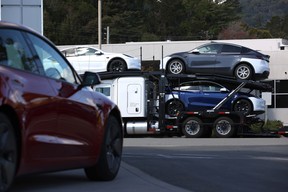
With them, of course, would go all the recent developments propping up the Canadian auto industry, like battery plants, mineral processors, and even some of the mining operations envisaged as part of our domestic EV revolution. This might not seem as immediately existential — only because there will endless lawsuits before the issue is resolved — as the tariffs currently dominating our news cycle, but it could be no less damaging to the auto industry.
Advertisement 4
Article content
Foxconn will produce an EV for Mitsubishi
Mitsubishi made big news this week when it announced it will be bringing a new electric vehicle to Canada next year. Co-developed with Nissan, it will be based on the next-generation Leaf platform, no big surprise since Japan’s smallest global automaker is part of the Renault-Nissan-Mitsubishi Alliance formed precisely to cut costs by sharing both research and development, as well as manufacturing.
Making far less noise was the announcement just a couple of days later that Mitsubishi will also be launching another new EV in 2026, this one for the Australian and New Zealand markets, and pointedly not manufactured by Nissan. In fact, this one looks like a contract job with all — or most — of the engineering done by famed iPhone producer (and fledgling automaker) Foxconn. It will even be produced in Foxconn’s home country of Taiwan.


Why this matters
Australia and New Zealand may be far away — actually, you can’t get much farther away from Toronto than Sydney and still breathe the Earth’s atmosphere — and their markets relatively minuscule, but this announcement is significant in numerous ways.
For one, as I just mentioned, Mitsubishi is in an alliance with Renault and Nissan, and is, outwardly at least, especially reliant on the latter. That it would contract out production to a non-alliance member is big news. It also, sadly, points to how far Nissan’s fortunes have fallen. Nissan’s original Leaf ushered in the era of battery-powered cars amongst legacy automakers, and the company looked not so very long ago to be the leaders in electrification. In other words, had everything gone to plan, one would have expected this other new EV to be another Nissan-built Mitsubishi.
Advertisement 5
Article content
Indeed, this seems like another example of the rapid reversal of fortunes for the two alliance partners. Nine years ago, when the latest version of the partnership was formed, Mitsu was definitely the junior partner. But, with Nissan’s recent fortunes flagging and Mitsubishi’s flying high, it looks very much like there’s been a change in the power dynamic.
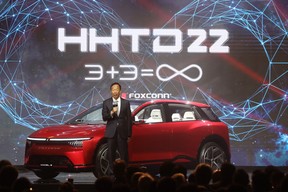
It’s also worth remembering that not too long ago, Foxconn tried to buy a piece of Nissan, with an eye to jointly producing EVs. It was rebuffed, but now seems to have made a deal with Nissan’s closest partner. What the Taiwanese company’s ultimate goal may be remains undetermined, but the one thing that is obvious is that Nissan has not been the same since the corporate coup that ousted former CEO Carlo Ghosn.
Ford says it’s figured out how to build cheap EV batteries
And finally, because we’d like a bit of good news, especially if it comes from a local manufacturer, Ford recently announced that it is developing a new range of EV batteries. Taking an opposite tack to China’s CATL, which recently unveiled a super-fast-charging but über-expensive new bit of EV tech, Ford wants to use manganese in its electric vehicles’ cells to reduce production costs.
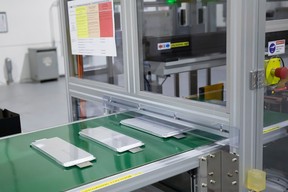
The Ford chemistry, like CATL’s, promises good energy density — for competitive range — but unlike CATL’s, only moderate charging speeds. However, because manganese is more plentiful — that should be read “cheaper” — than either nickel or cobalt, such a chemistry might make Ford the first legacy automaker to develop a battery that might be cost-competitive with the LFP cells championed by Chinese automakers. According to Levine, Ford is confident that it has overcome the production and durability challenges that have stricken others.
Advertisement 6
Article content
Why this matters
Battery start-ups have long looked to manganese to reduce production costs. Even Chinese automakers, well known for their leadership in battery manufacturing, have failed in their attempts to maximize manganese content. The closest anyone has come is to add a little of the hard, brittle metal — also used in steel production — to a conventional lithium-iron-phosphate battery to create a mongrel LFMP chemistry. So, if Ford succeeds, it would be the first American automaker to go where the Chinese have failed before.
And Ford seems confident it can. Charles Poon, director of electrified propulsion engineering, said on April 23 — you might have missed it because we were, well, in full tariff meltdown — that it expects most of its products to be powered by lithium-manganese-rich (LMR) batteries by the end of the decade. “This isn’t just a lab experiment,” said Poon. “We’re actively working to scale LMR cell chemistry and integrate them into our future vehicle lineup within this decade.” More pointedly, Poon says Ford’s objective is the “cost parity with gasoline vehicles” made possible by the longer range at lower cost that LMR promises.
That might not be Earth-shattering news, but it sure beats listening to Trump bleat on about his “beautiful” tariffs, and how we’d all be better off as the 51st state.
Sign up for our newsletter Blind-Spot Monitor and follow our social channels on X, Tiktok and LinkedIn to stay up to date on the latest automotive news, reviews, car culture, and vehicle shopping advice.


David Booth
David Booth is Driving’s senior writer as well as the producer of Driving.ca’s Driving into the Future panels and Motor Mouth podcasts. Having written about everything from the exact benefits of Diamond Like Coating (DLC) on motorcycle camshafts to why Range Rovers are the best vehicles for those suffering from opiod-induced constipation, Booth leaves no stone unturned in his quest for automotive veritas. Besides his long tenure with Driving, he was the editor in chief of Autovision magazine for 25 years and his stories has been published in motorcycle magazines around the world including the United States, England, Germany and Australia.
Education
Graduating from Queen Elizabeth High School in 1973, Booth moved to from his Northern Quebec home town of Sept-Iles — also home to Montreal Canadiens great, Guy Carbonneau, by the way — to Ottawa to study Mechanical Engineering at Carleton University where he wrote a thesis on the then burgeoning technology of anti-lock brakes for motorcycles and spent time researching the also then burgeoning use of water tunnels for aerodynamic testing.
Experience
After three years writing for Cycle Canada magazine and another three working for the then oldest magazine in Canada, Canadian Automotive Trade, Booth, along with current Driving writer, Brian Harper, and then Toronto Star contributor, Alex Law, created an automotive editorial services group that supplied road tests, news and service bulletins to what was then called Southam newspapers. When Southam became Postmedia with its purchase by Conrad Black and the subsequent introduction of the National Post, Booth was asked to start up the then Driver’s Edge section which became, as you might suspect, Driving.ca when Postmedia finally moved into the digital age. In the past 41 tears, Booth has tested well over 500 motorcycles, 1,500 passenger cars and pretty much every significant supercar of the last 30 years. His passion — and, by far, his proudest achievement — however is Motor Mouth, his weekly column that, after some 30 years, remains as incisive and opinionated as ever.
Personal
Booth remains an avid sports enthusiast — that should be read fitness freak — whose favourite activities include punching boxing bags until his hands bleed and running ski hills with as little respect for medial meniscus as 65-year-old knees can bear. His underlying passion, however, remains, after all these years, motorcycles. If he’s not in his garage tinkering with his prized 1983 CB1100RC — or resurrecting another one – he’s riding Italy’s famed Stelvio Pass with his beloved — and much-modified — Suzuki V-strom 1000. Booth has been known to accept the occasional mojito from strangers and the apples of his eye are a certain fellow Driving contributor and his son, Matthew, who is Global Vice-President of something but he’s never quite sure what. He welcomes feedback, criticism and suggestions at David@davebooth.ca
link