“What if this was the car they really wanted to build in 1961?”
Will Posey is posing a question that can’t really be answered, yet has broad implications when it comes to collector vehicles. The car is a 1961 Chevrolet Impala Bubble Top, heavily modified and dubbed “Dirty Martini.”
Posey designed and built the car at his shop, Big Oak Garage in Hokes Bluff, Alabama for owner Dan Duffy. While it has the bearing of a ’61, very little hasn’t been transformed. The chassis is from Roadster Shop, the 650-horsepower W-code V8 is specific to the car, by Lamar Walden Automotive. Posey extended the hood, changed the quarter panels, dropped the top by more than four inches and more.

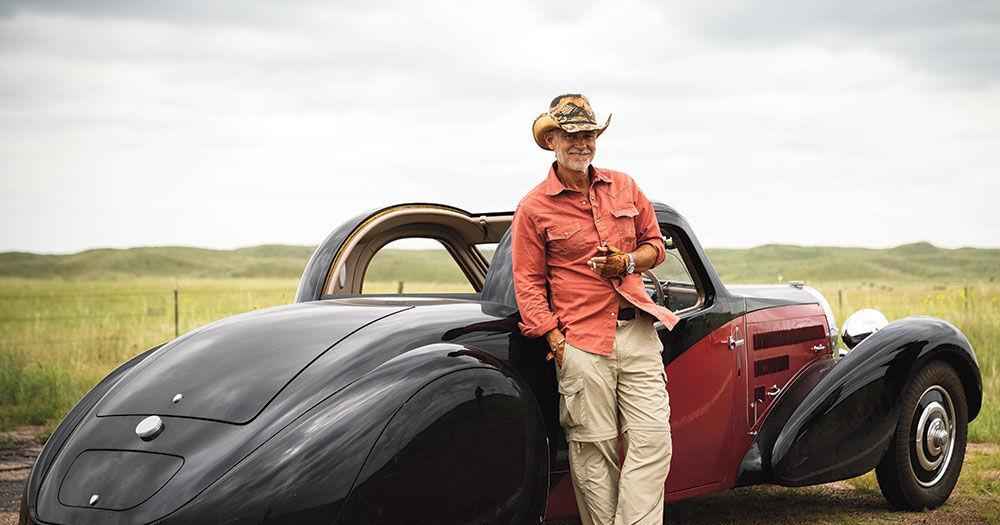
Fritz Burkard pauses while on his cross-country trip. He advocates for collector cars to be driven regularly.
“You’re basically rebuilding the entire structure of the car,” he explains. “We got some hate for messing with the roof.”
But Dirty Martini is an award-winner. It is also an indication of change.
While some collectors cross boundaries, there are divisions. Those who collect classics, for example, tend to prize originality. They scorn even modest improvements for performance and safety. Others prefer hot rods or customs. And many insist that investment grade vehicles should be kept off the road as much as possible, as wear and mileage will affect the value.
“Who wrote that rule?” says Swiss auto enthusiast Fritz Burkard, who is showing a 1936 Bugatti Type 57S Atalante at Concours d’Elegance. He actually drove the vintage machine from Newport, Rhode Island to the show field at Pebble Beach.
A year ago, Burkard’s 1934 Bugatti Type 59 Sports took Best of Show at Concours, the first preservation class car to claim top honors. Preservation class refers to cars that are virtually unaltered since new.
“I drove it every day of the week – Highway 1, 17-Mile Drive, to Carmel for coffee,” he says with a chuckle. “On Sunday I won Best of Show.”
Burkard is not one to abuse a classic. He began pursuing cars almost 40 years ago, and his Pearl Collection includes around 90 of the more sought-after machines. But he insists that even those purchased as an investment should be enjoyed, not just parked.
“Those people miss 70 to 80 percent of the fun,” Burkard says. On the road to Car Week, he received “a lot of thumbs up, a lot of conversations at the gas station. That’s why you do this, to meet interesting people.”
Posey believes that younger generations of car enthusiasts are more accepting of modification and are the reason the old lines are beginning to vanish. According to the consulting firm McKinsey & Company, more recent vintages have been keeping collector car values steady. In 2012, the average age of cars on the auction floor was 54 years. By 2024, that figure had dropped to 38 years, as models built between 1980 and 2010 gained in popularity.
As interests changed, Monterey’s Car Week – once referred to as Classic Car Week – began to evolve. A show of exotic sports cars became a regular feature, first on Cannery Row and now along Broadway in Seaside. More boutique manufacturers began to unveil new models at Car Week events. Two years ago, the staid Concours d’Elegance featured hot rods on the field. Last year, the McLaren F1 was on display.
“We have expanded the show field to include all types of cars,” explains Gabriel Garza, director of operations for the Pebble Beach destination event.
Data collected by Hagerty from the Monterey Car Week auctions in 2024 confirm the trend. Pre-1981 cars at the $1 million or more estimate had a sell-through rate of 52 percent, compared to 73 percent for more recent models.
Mecum Auctions, the house known for muscle cars elsewhere, brought a lineup loaded with Porsches, Ferraris, Auburns and Cords to Monterey. This year Mecum not only offers Dirty Martini at an estimate of up to $550,000, but also a modified 1967 Pontiac GTO known as “Twisted,” in part for its asphalt-ripping 1,000-horsepower engine.
“They are always going to be kind of separate,” Twisted’s owner, Steve Aguilar, says of the different collecting camps. “But I tried to make the car so that anyone with a vintage Bugatti would say, ‘Wow!’”
Like Dirty Martini, Twisted has come away with multiple awards. And it is the result of heavy modification – right down to the custom ignition key and fob. Yet it has the look of a GTO, only with more power, better braking and a modern interior.
“We didn’t want to destroy the look of the car,” Aguilar says. “We just made improvements.”
Writing in Hagerty Insider, a magazine devoted to collector cars, Dave Kinney noted that the avocation has changed in the past. “In the early days of car collecting… even top-tier collectors cared relatively little about originality,” he observed, adding that restoration shops thought nothing of replacing parts to make the vehicle better.
In the 1990s and 2000s, however, the high-end market became much more particular. The preservation class was born from the ethic of sticking to originality. Even faded color became more important than a gleaming new paint job.
Car owners like Duffy and Aguilar want past and present in one package.
“To me, when you’re modifying a car, nothing should stick out,” Posey agrees. “You give it a modern flair without taking away the history.”
To his point, if designers in 1961 had access to the same technology, would they have produced something similar to Dirty Martini?

“We crossed the country numerous times with the car,” says Dan Duffy, owner of the custom 1961 Chevrolet Impala known as Dirty Martini. “We made a ton of friends.”
The “resto-mod” segment of the collector world prefers to restore and modify. Even pre-war models can be given reliable powertrains and brakes, as well as be converted for fuel efficiency and a reduced carbon footprint.
“They are uncomfortable,” Aguilar says of 1960s muscle cars like the GTO, citing vinyl seats with little cushion and soft springs. “The GTO dashboard in ’66-’67 – whoever designed it must have done so on a Monday morning after a bender.”
Aguilar draws inspiration from European exotics. Where Posey imagines designers of the past styling with modern sensibilities, Aguilar ponders the implications if the GTO had been a product of Stuttgart or Maranello.
“To get into this game, it’s just as much as the European exotics,” he points out. “Those projects are $700,000 to $1 million or more.” But he agrees with Burkard. “I don’t want it sitting in a garage. You have to enjoy it.”
Another indication of the convergence of changing tastes and current technology is the number of manufacturers adopting the modified ethic, at least on a small scale. Aston Martin, for example, produced modern versions of the DB4GT and the DB4GT Zagato, a pair of rare sports cars.
Meanwhile, the spirit is taking hold with even veteran collectors. Once Twisted sells, Aguilar has his eye on a 1970 Buick Gran Sport, another custom project.
“As long as you are passionate about it, it doesn’t matter what type of car it is – custom, hot rod,” Burkard says. “It’s fun.”
link